
01
Pain with the first step in the morning
The first step after you get up
feels like a stabbing pain.
So your first step in the morning
isn't something to dread.
A day when your first step out of bed doesn't hurt, and evenings aren't something to dread even after standing all day. Getting that day back is the goal of this care.
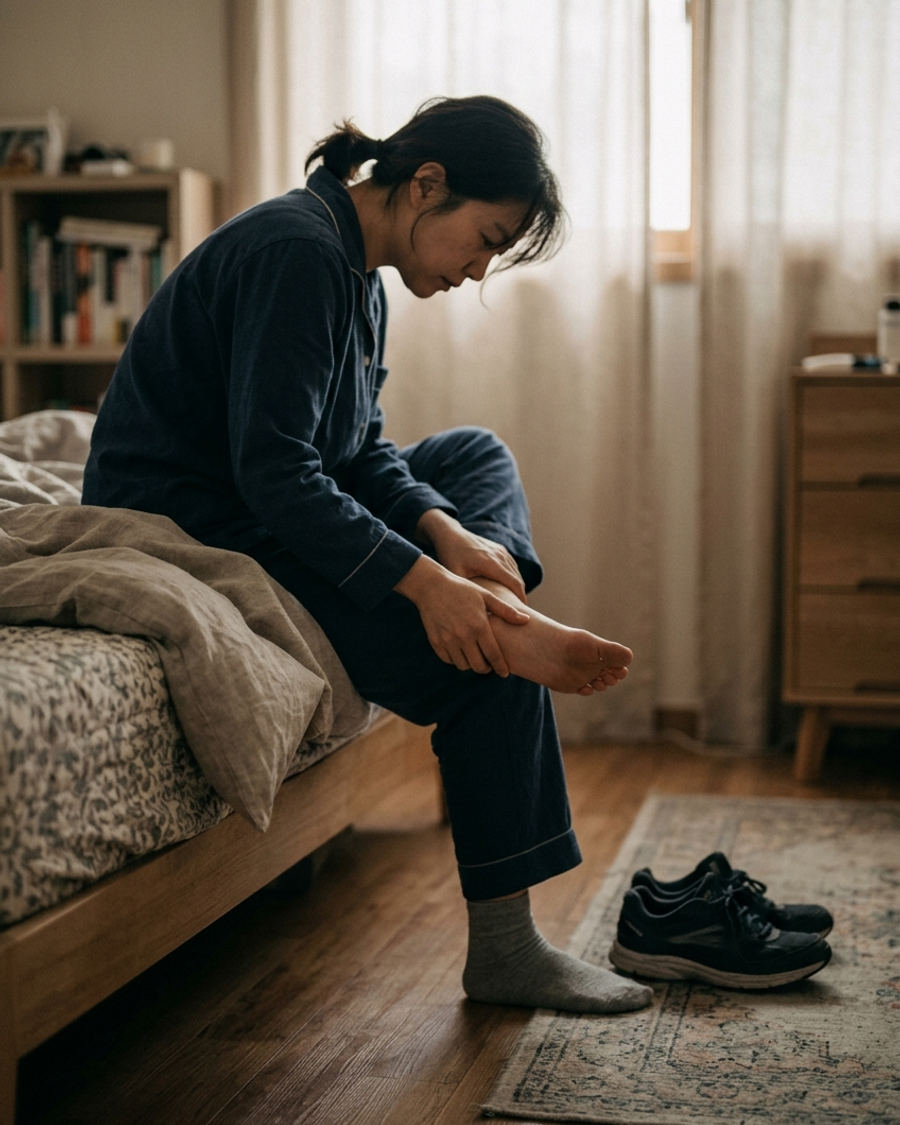
Your feet are the only part of your body that touches the ground.
If something is off here, it travels all the way up.
Once you get used to favoring a sore foot, the other knee and your lower back end up doing the extra work. Many people come to us only after the pain has spread to more places.
The first step after you get up
feels like a stabbing pain.
You bought some and tried them,
but they made things worse.
After walking a long time, your knees ache
and your lower back starts to hurt.
Your soles wear down on only one side,
and you stand at a slight tilt.
We don't just look at the foot and fix the foot.
People who come in with plantar fasciitis usually have two things going on at once.
One is a fallen arch.
When the arch collapses, the strain piles up where the fascia attaches to the bone, and that spot becomes inflamed.
The other is the pelvis.
When the pelvis tips forward, your stride gets shorter, and instead of landing heel first, you start landing on the middle of your foot.
Because the heel gets used less, that area stiffens up.
So first we loosen the pelvis and the iliopsoas muscle so you land on your heel properly, and we treat the inflamed area with pharmacopuncture and acupuncture.
For some people, that's enough.
If it still doesn't get better, it means the cause is still there.
That's when we lift the fallen arch.
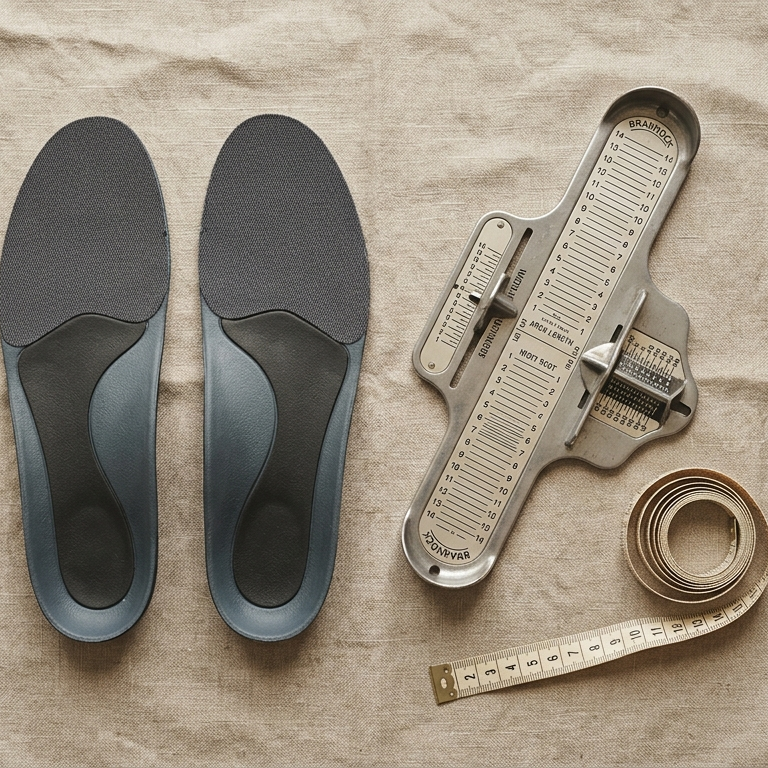
We measure your feet and make insoles that fit them.
How things go depends on each person's condition.
When inflammation has settled into the plantar fascia
Calming the inflammation and supporting the foot
We loosen the stiff fascia and calves, and support the arch so it doesn't get pulled tight again while you walk.
→ The pain when you first step down in the morning settles down.
When the arch has collapsed and can't absorb impact
Foot measurement and custom insoles
We measure where your arch gives way and design insoles to fit your feet.
→ Less fatigue builds up over the day, so evenings are easier to face.
When misalignment that started in the feet has traveled upward
Foot and pelvic correction together
We correct the way you step and also realign what has shifted further up.
→ The strain that started in your feet stops traveling upward, and your walk becomes more even.
We don't start with the feet.
We realign the pelvis so you land on your heel, and if problems remain, we lift the arch.
We press gently on the sore side and firmly on the other. One side hurts even with a light touch, the other doesn't hurt even with firm pressure. That difference shows where you are now.
We check whether your pelvis tips forward, and how much that has shortened your stride. Often, the reason the foot has stiffened up isn't in the foot at all.
We look at which side of the sole wore down first and where calluses have formed on the bottom of your foot. What shoes you wear and how much you walk in them matters as much as treatment.
Easing that pain is our first goal.
A. Every foot is shaped differently, but ready-made insoles come in a fixed shape. The difference is that we measure your feet and design the insoles to fit them. Insoles that don't fit can actually make things worse.
A. When the pelvis tips forward, your stride gets shorter. With a shorter stride, instead of landing heel first, you start landing on the middle of the foot. Because the heel gets used less, that area stiffens. So if we only loosen the foot and leave the pelvis as is, it stiffens up again as you walk.
A. Not everyone with flat feet has problems. If you have pain, or it's starting to affect your knees or lower back, it's a good idea to have it checked.
A. Yes. While children are growing, the condition of their feet affects their posture and growth, so it's better to check early.
A. Sometimes correcting the feet alone helps, but if it has already affected your knees or lower back, we need to look at those too. We'll tell you after checking your condition.
A. No. First we treat the inflamed area with pharmacopuncture and acupuncture and see whether it improves. For some people, that's enough, and then we don't go further. If it still doesn't get better, it means the cause is still there, and that's when we move on to lifting the arch.
A. When you walk with the inner arch supported from below, a fallen arch rises again. As the arch finds its place, some people find the pain eases within a few days. How long it takes, though, depends on how far the arch has fallen and how much you walk.
A. Once they're made, they last a long time. I used my first pair for seven years. We also adjust them for a year. At around 6 months, we'll contact you first. If you wear them faithfully your feet change, so we adjust them once more to match.
A. Pain can flare up right after new insoles are fitted or the height is adjusted. We mention this ahead of time because if you don't know, you may think the insoles are wrong and stop wearing them. As your walk changes, parts that weren't being used start working. If it's very uncomfortable, let us know and we'll readjust the height.
의료진이 직접 전하는 건강 정보입니다.
Heel pain that is worst with the first step after getting out of bed is the hallmark of plantar fasciitis. That's because the spot that healed slightly overnight gets pulled again under your morning body weight. Most cases get better within 10 months, but 1 in 10 lasts a long time. The treatment with the strongest evidence isn't an injection or a machine. It's a stretch that pulls the toes back to lengthen the plantar fascia itself.
Patients tell us their knees are swollen and painful, every step is hard, and going down stairs makes them nervous. Often the lower back is uncomfortable too. Because it hurts, they walk less; because they walk less, their legs get weaker; and then it hurts more. They come to us after living inside this loop.
Patients tell us their foot hurts as if it's tearing when they take their first step getting out of bed in the morning. It eases a little after walking, but gets worse as the day goes on. Often the sole and the area just above the heel hurt together. What's distinctive here is that it's only on one side. In many cases, the person has been favoring the other side for a long time.
We've answered the questions we hear most often in clinic, one question per article.
Feel free to start with whatever you're curious about.