
01
A burning chest
Sour acid comes up, your chest burns,
and it feels like something is stuck in your throat.
Instead of adding more medication,
toward meals that sit comfortably.
A day when you don't regret eating, don't wake up to sour acid in your throat, and don't cover your mouth when talking up close. Getting that day back is the goal of this care.

If your tests are clear but you're still uncomfortable,
there's a place no one has looked at yet.
Many people spend years with the burning coming back every time they stop their medication. Meanwhile they eat less, and their energy drains away too.
Sour acid comes up, your chest burns,
and it feels like something is stuck in your throat.
You've taken acid blockers for a long time,
but the cough and lump-in-the-throat feeling haven't changed.
The pit of your stomach feels blocked,
and you stay uncomfortable long after eating.
Even after brushing and a dental cleaning,
you worry about it when talking up close.
It hurts when you press around the pit of your stomach and navel,
and your whole body feels heavy and tired.
Acid-suppressing medication has the advantage of calming the burning quickly.
It's closer to switching off the fire alarm.
Once the alarm is off, things go quiet for now. But the fire itself is still there.
We're not telling you to stop medication you need. We mean that our job is the fire.
We look for where it starts in the blood flowing to the stomach.
When not enough blood reaches the stomach, stomach acid becomes diluted, and diluted acid digests food more slowly.
The body then tries to make up the shortfall with volume.
It overflows not because the acid is too strong, but because it's too weak, so more of it is produced.
So our treatment aims to get blood circulating to the stomach again — with herbal medicine, pharmacopuncture, and visceral Chuna, where we work directly on the abdomen by hand.
Progress varies with each person's condition.
Weak, sluggish stomach with food stagnation — the stomach isn't moving well
A prescription to get the stomach moving
Improves motility to clear stagnation and support digestion.
→ The blocked feeling after even a small meal eases, and your belly softens.
Liver–stomach disharmony — heat rising upward
A prescription to clear heat and protect the lining
Brings down rising heat and calms inflammation of the esophageal lining.
→ Waking up to sour acid becomes less frequent, and the stuck feeling in your throat fades.
The intestines are cold and not working well
A prescription to warm the intestines
Warms the belly to even out bowel movements and support absorption.
→ Food spends less time in the stomach, so the odor rising to your mouth eases too.
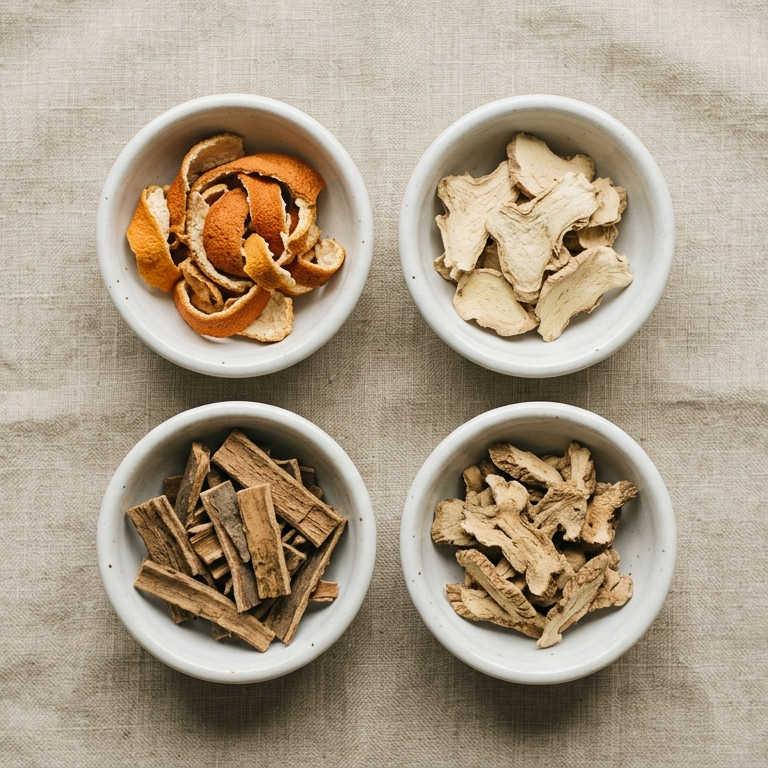
We work toward getting blood circulating to the stomach again.
As we check by hand where it's tight and where it hurts, we also check the temperature.
Then we have you place your own hand and feel it. It's quicker to understand when you feel for yourself that this spot and that spot are different temperatures. There's fat on both sides, so if only one side is cold, less blood is reaching that area.
Digestion has three stages: swallowing food down, breaking it down in the stomach, and absorbing it in the small intestine.
The medicine we use depends on which of the three is blocked. We'll point to that stage and explain.
A lump-in-the-throat feeling can't always be explained by the stomach alone.
When you eat what, and when you lie down, plays a big part.
If there are warning signs, an endoscopy comes first.
Sum up how your stomach has felt over the past two weeks in eight questions.
The result doesn't diagnose a disease. It organizes things so you can bring it to your visit.
A. An endoscopy looks for inflammation or ulcers in the lining. It can't show functional problems, like how well the stomach moves or whether enough blood is reaching it. Reduced function may be the cause.
A. When not enough blood reaches the stomach, stomach acid becomes diluted. Diluted acid can't digest food on time, so the body tries to make up the shortfall with volume. That extra stomach fluid then overflows upward. It does overflow, but not because it's strong. It's weak, so more is produced, and then it overflows.
A. This is when, on top of the acid problem, the stomach also isn't moving well physically. Food sits instead of moving down, gas builds up, and the burping keeps coming. In this case we combine herbal medicine with visceral Chuna, where we work on the abdomen by hand.
A. Sometimes they're needed. We don't recommend stopping suddenly on your own.
When acid secretion is suppressed, the body keeps stockpiling signals telling it to make acid. If the medication is then removed, everything that built up is released at once, and things can actually get worse. One study found that even in healthy people with no reflux symptoms at all, 44% developed symptoms after taking the medication for 8 weeks and then stopping (summary of the evidence).
So we start while you keep taking your current medication as is. When it's time to cut down, we'll guide you to talk it over with the prescriber, bringing your records with you. How much and how fast to reduce is for the prescriber to decide. Our part is helping your body get to where that decision becomes possible.
A. When the approach is to help the stomach move on its own rather than to suppress symptoms, it often helps. But it depends on your condition, so we'll check during your visit and tell you.
A. The first step is to have a dentist check your gums and teeth for problems. If they say everything is fine and the odor still won't go away, we look at your stomach too. When digestion is slow and food stays a long time, the odor can rise upward.
A. It's best to avoid them during treatment, but once your stomach function recovers, having them now and then is fine.
A. Even with a cold, you cough less while you sleep, because the brain switches off the cough reflex during sleep. But it can't switch off the airway irritation caused by reflux. That's why you cough at night, and it's worse when you lie down. Some people come in for a nighttime cough alone, and it turns out to be reflux.
A. That's a symptom that tends to come along with it. When a lot of stomach acid is being produced, the acidity is off further down as well. So people with reflux often have bowel problems too, whether constipation or diarrhea. When you have to go right after eating or can't hold it for long, we call it "stinging stools." We don't look only at the stomach and forget what's below.
A. When food is absorbed well, the brain sends a signal to stop eating. When it isn't absorbed, a signal to eat more goes out instead. That's why you keep wanting to eat even when your stomach feels full, and why sweets in particular are so tempting. We don't see it as a matter of willpower.
A. It can, so we ask first and then decide. Sometimes liquids can actually trigger reflux. We adjust when you take it and how much, or switch to a different form. If it bothers you after you try it, please tell us right away. Putting up with it won't help.
의료진이 직접 전하는 건강 정보입니다.
During the day it's more or less manageable. The problem is the moment you lie down. So you stack two or three pillows, and some nights you fall asleep propped up on the sofa. When you lie down, the esophagus and stomach become level, and during sleep you swallow less of the saliva that washes acid back down. Three ways to reverse those conditions have been confirmed with numbers.
I've been feeling a bit better lately, so maybe I'll skip it tonight. Then a few nights later, you wake up to acid worse than before. Drinking water in the early hours, you conclude: my stomach just can't do without the medicine. But that night may not be proof that your stomach is broken. It may be a predictable reaction that happens when a medication is suddenly taken away.
It's fine while you take the medication, but within a week or two of stopping, it comes back up. There's a mechanism behind this called rebound. Even in healthy people with no reflux symptoms at all, 44% developed acid regurgitation and heartburn after taking an acid-suppressing drug for 8 weeks and then stopping. We've summarized the evidence on what you can do without stopping your medication on your own.
We've written up the questions we hear most often in practice, one per article.
Feel free to start with whatever you're most curious about.